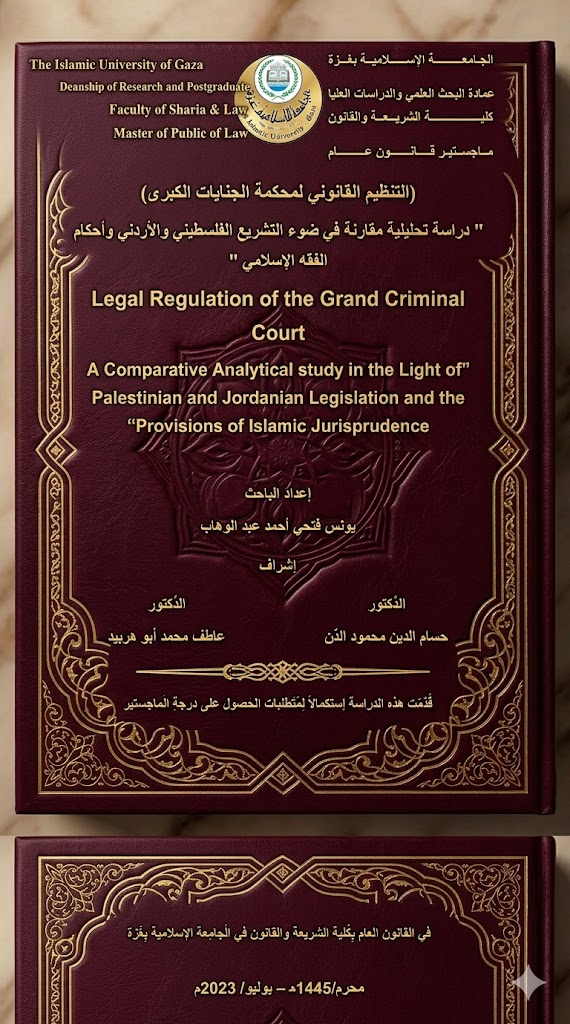
التنظيم القانوني لمحكمة الجنايات الكبرى دراسة تحليلية مقارنة في ضوء التشريع الفلسطيني والأردني وأحكام الفقه الإسلامي
التنظيم القانوني لمحكمة الجنايات الكبرى دراسة تحليلية مقارنة في ضوء التشريع الفلسطيني والأردني وأحكام الفقه الإسلامي
من إعداد الباحث يونس فتحي أحمد عبد الوهاب
ملخص الدراسة
إنشاء محاكم الجنايات الكبرى من دلائل الفكر القضائي على الرغبة في التخفيف عن القضاة في مسألة تكدس القضايا المنظورة على اختلاف أنواعها، لذلك فقد أقدم الباحث على هذه الدراسة رغبة في توضيح هذه المحكمة ومكوناتها واختصاصاتها، حيث أنه ومن خلال هذه الدراسة؛ سلط الباحث الضوء على محكمة الجنايات الكبرى لأهمية هذه الدراسة من الناحيتين العلمية والعملية، نظراً لشح الدراسات المقدمة في هذا الجانب، بالإضافة إلى التيسير على القانونيين والعوام في فهم اختصاصات وإجراءات محكمة الجنايات الكبرى، وتهدف هذه الدراسة بشكل رئيس إلى تقديم رؤية واضحة حول التنظيم القانوني لمحكمة الجنايات الكبرى، لاسيما في التشريع الفلسطيني، ومقارنتها بالتشريع الأردني، وأحكام الفقه الإسلامي، وتحديد اختصاصاتها. وتكمن إشكالية الدراسة في ضرورة البحث في القانون الذي ينظم ويحكم عمل محكمة الجنايات الكبرى، ويبين اختصاصاتها والإجراءات الواجب اتباعها أمام تلك المحكمة، ولتحقيق أهداف هذه الدراسة اعتمد الباحث المنهج الوصفي التحليلي والمنهج المقارن، مستخدماً أدوات الاستقراء والملاحظة وتحليل النصوص القانونية في التشريع الفلسطيني ومقارنتها، وذلك بهدف الإجابة على التساؤلات كافة ومن ثم الوصول إلى تحقيق هدف الرسالة، وتناول الباحث في الفصل الأول ماهية محكمة الجنايات الكبرى وتشكيلها، وبيّن الباحث في الفصل الثاني اختصاصات محكمة الجنايات الكبرى وآليات ممارساتها، وأخيراً تناول الباحث في الفصل الثالث إجراءات المحاكمة أمام محكمة الجنايات الكبرى. وفي الخاتمة توصل الباحث إلى جملة من النتائج، من أبرزها أن محكمة الجنايات الكبرى هي محكمة ضمن تشكيل المحاكم النظامية متخصصة بنظر جرائم محددة بناءً على قانون، ويتولى تشكيلها وتنظيم الأعمال المنوطة بها ويحدد إجراءاتها وأماكن انعقادها قانون يسمى قانون محكمة الجنايات الكبرى، كما خلصت الدراسة إلى أن قانون الإجراءات الجزائية هو الذي يحكم عمل محكمة الجنايات الكبرى، وأنها تتبع قواعد قانون العقوبات وتصدر احكامها بناءً على ذاك القانون ايضاً.
وأن الشريعة الإسلامية لا تمانع مثل هذا التنظيم في المحاكم، ولا ترفض التخصصية في القضاء طالما أن ذلك يهدف إلى الوصول إلى الحقيقة وتحقيق العدالة. ومن أبرز التوصيات التي توصلت اليها الدراسة، التوصية بضرورة توحيد النظام القضائي وتشكيلاته، كما يوصي الباحث بضرورة إعداد وإصدار قانون يحكم عمل محكمة الجنايات الكبرى.
Abstract
The establishment of Grand Criminal Courts was an indicator of the judicial thinking’s desire to alleviate the burden on judges regarding the backlog of various types of cases. Consequently, the researcher presented this study to clarify the nature of this court, its components, and its jurisdictions.
Through this study, the researcher shed light on the significance of the Grand Criminal Court from both a scientific and practical perspective, given the scarcity of studies in this area. Additionally, it aimed to facilitate the understanding of its jurisdictions and procedures for legal professionals and the general public.The main objective of this study was to provide a clear understanding of the legal organization of the Grand Criminal Court, particularly in Palestinian legislation, by comparing it with Jordanian legislation and Islamic jurisprudence.
The study’s challenge lay in exploring the law that regulated and governed the Grand Criminal Court’s work, delineated its jurisdictions, and outlined the procedures to be followed before this court.To achieve the study’s objectives, the researcher used the descriptive-analytical and comparative methods, utilizing tools such as induction, observation, and analysis of legal texts in Palestinian legislation and its comparison. The study aimed to address all inquiries and ultimately achieve the research’s goal.The first chapter discussed the nature and formation of the Grand Criminal Court, while the second chapter focused on its jurisdictions and operational mechanisms.
Finally, the third chapter delved into the trial procedures before the Grand Criminal Court.In conclusion, the researcher arrived at several findings, notably that the Grand Criminal Court was a specialized court within the judicial system responsible for examining specific crimes based on the law. Its formation, organization, functions, procedures, and locations were governed by a law called the “Grand Criminal Court Law.”
The study also concluded that the Criminal Procedure Law governed the work of the Grand Criminal Court, and its verdicts were based on the Penal Code. Islamic law does not object to such organization in the courts, and does not reject specialization in the judiciary as long as this aims to reach the truth and achieve justice. Among the study’s recommendations was the necessity to unify the judicial system and its formations.
Additionally, the researcher recommended the preparation and enacting a law that governs the operations of the Grand Criminal Court.